Home  Writing
Philosophies
Aristotle's Syllogism
Writing
Philosophies
Aristotle's Syllogism
|
Home |
|
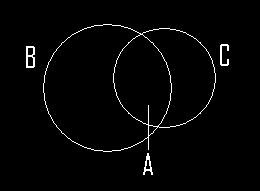
Consider one of Aristotle’s syllogisms: All A are B. All A are C. Therefore some B are C. Why is this not an entirely sound argument? Or, in what case would the argument fail? Hint: Reducing the argument to simple Venn diagram might help.
If all the elements of set A are elements of set B, and all the elements of set A are also elements of set C, then the elements of set A form the intersect of sets B and C (Aristotle’s conclusion, Some B are C). The argument fails though if set A is an empty (or null) set. In this case, no element of set B is an element of set C. Aristotle’s argument would have been deductively valid (or infallible) if he eliminated the possibility of set A being empty. So, his syllogism should have been:
20 July 2003 |